

Reverse osmosis membrane contamination
1. The performance of the Ro Membrane is damaged, resulting in membrane fouling
(1) Polyester material reinforced non-woven fabric, about 120 μm thick; (2) Polysulfone material porous middle support layer, about 40 μm thick; (3) Polyamide material ultra-thin separation layer, about 0.2 μm thick.
According to its performance structure, if the performance of the permeable membrane is damaged, there may be the following reasons:
(1) The maintenance of the new reverse osmosis membrane is not standardized; (2) The storage time exceeds 1 year when the maintenance meets the requirements; (3) The maintenance of the reverse osmosis membrane is not standardized when it is out of operation; (4) The ambient temperature is below 5℃ ; (5) The system is running under high pressure; (6) Improper operation when shutting down.
2. Membrane fouling due to frequent changes in water quality
The raw water quality has changed from the designed water quality, which increases the pretreatment load. Since the incoming water contains more impurities such as inorganic matter, organic matter, microorganisms, particulate matter and colloids, the probability of membrane fouling increases.
4. Dosing medicine incorrectly
When the composite polyamide membrane is in use, because the polyamide membrane has poor resistance to residual chlorine, chlorine and other disinfectants are not added correctly during use, and the user does not pay enough attention to the prevention of microorganisms, which can easily lead to microbial contamination.
5. Membrane surface wear
The membrane element is blocked by foreign matter or the membrane surface is worn (such as sand, etc.). In this case, the detection method must be used to detect the components in the system, find the damaged components, modify the pretreatment, and replace the membrane components.
The phenomenon of reverse osmosis membrane fouling
During the reverse osmosis operation, due to the selective permeability of the membrane, some solutes accumulate near the membrane surface, resulting in membrane fouling.
Common signs of fouling include the following: One is biological fouling (symptoms appear gradually). Organic sediments are mainly living or dead microorganisms, hydrocarbon derivatives, natural organic polymers and all carbon-containing substances. The initial manifestations are increased salt rejection, increased pressure drop and decreased permeate. Then there is colloidal fouling (symptoms gradually appear). During the membrane separation process, the concentration of metal ions and changes in the pH value of the solution may be the deposition of metal hydroxides (mainly represented by Fe(OH)3), causing fouling. Blocking. Initially, the salt rejection rate decreased slightly, and gradually increased, and finally the pressure drop increased and the permeate decreased. There is also particle fouling. During the operation of the reverse osmosis system, if there is a problem with the security filter, particulate matter will enter the system and cause particulate fouling of the membrane.
The initial manifestation is that the flow rate of concentrated water increases, the desalination rate does not change much in the initial stage, the water production gradually decreases, and the system pressure drop increases rapidly. The last common one is chemical scaling (symptoms appear quickly). When the feed water contains high levels of Ca2+, Mg2+, HCO3-, CO32-, SO42- and other ions, CaCO3, CaSO4, MgCO3 and other scales will be deposited on the membrane surface. It is manifested by a decrease in the desalination rate, especially in the last section, and a decrease in water production.
Membrane fouling is the main reason for the decrease in membrane permeate flow. Including the blockage of membrane pores and macromolecular solutes, which causes an increase in membrane filtration resistance; solute adsorption on the inner wall of the pores; and the formation of a gel layer on the membrane surface, which increases mass transfer resistance. The deposition of components in the membrane pores will cause the membrane pores to be reduced or even blocked, which actually reduces the effective area of the membrane. The additional resistance generated by the fouling layer formed by the deposition of components on the membrane surface may be much greater than the resistance of the membrane itself, making the permeate flow rate independent of the permeability of the membrane itself. This effect is irreversible. The degree of pollution is related to the membrane material, the concentration and properties of the solvent in the retention solution and macromolecular solutes, the pH value of the solution, ionic strength, charge composition, temperature and operating pressure. When the pollution is serious, the membrane can be damaged. Flux drops by more than 80%.
During the operation of the system, membrane fouling is a very thorny problem. Its occurrence has caused a substantial decrease in the removal rate, water permeability, and membrane flux of the reverse osmosis device. At the same time, it has increased the operating pressure of each section, prompting operation and operation. The rising cost seriously affects the service life of the membrane and the development and utilization of reverse osmosis technology.
Solution
1. Perfect preprocessing
For each set of membrane devices, people hope that it will function to the maximum extent, hope to have the highest desalination rate, the largest water permeability and the longest possible life. To achieve the above three points, the quality of water supply is crucial, so The raw water entering the membrane device must have good pretreatment. Reasonable pretreatment is very important for the long-term safe operation of reverse osmosis equipment. With pretreatment that meets the requirements of reverse osmosis incoming water quality, it is possible to ensure that the product water flow rate remains stable; the salt rejection rate remains at a certain value for a long time; the product water recovery rate can remain unchanged; operating costs are minimized; and the membrane service life is Wait longer. Specifically, reverse osmosis pretreatment is to: (1) Prevent contamination on the membrane surface, that is, prevent suspended impurities, microorganisms, colloidal substances, etc. from adhering to the membrane surface or fouling the water flow channel of the membrane element. (2) Prevent scaling on the membrane surface. During the operation of the reverse osmosis device, due to the concentration of water, some insoluble salts are deposited on the membrane surface, so the formation of these insoluble salts must be prevented. (3) Ensure that the membrane is protected from mechanical and chemical damage so that the membrane has good performance and a long enough use time.
2. Clean the membrane
Although the feed liquid has undergone various pretreatment measures, deposition and scaling may occur on the membrane surface after long-term use, causing the membrane pores to become clogged and the water production to decrease. Therefore, regular cleaning of the contaminated membrane is necessary. However, the reverse osmosis membrane system cannot be cleaned until the pollution is serious. This will increase the difficulty of cleaning, increase the number of cleaning steps, and prolong the cleaning time. It is necessary to correctly grasp the cleaning time and remove dirt in time.
Cleaning principle:
Understand the local water quality characteristics, conduct chemical analysis of pollutants, and select the best cleaning agent and cleaning method through result analysis, providing a basis for finding the best method under specific water supply conditions;
Cleaning conditions:
a. The product water volume is 5%-10% lower than normal.
b. In order to maintain the correct product water volume, the water supply pressure after correcting the temperature is increased by 10%-15%.
c. The conductivity of the transmitted water (increased salt content) increases by 5%-10%.
d. For multi-stage RO systems, the pressure drop through different stages increases significantly.
cleaning method:
First perform system backflush; then perform negative pressure cleaning; perform mechanical cleaning if necessary; then perform chemical cleaning; ultrasonic cleaning can be performed if conditions permit; online electric field cleaning is a good method, but it is expensive; due to chemical The cleaning effect is relatively good, but other methods are not easy to implement. Although the names and usage methods of the agents provided by various suppliers are different, their principles are roughly the same. For example, our company now uses membrane cleaning agents MC2 and MA10.
The cleaning steps are as follows:
Cleaning single-stage system: (1) Configure cleaning fluid; (2) Low-flow input cleaning fluid; (3) Circulation; (4) Soaking; (5) High-flow water pump circulation; (6) Flushing; (7) Restart the system.
Cleaning for special pollutants includes: cleaning sulfate scale, cleaning carbonate scale, cleaning iron and manganese pollution, cleaning organic pollution, etc.
Maintenance of new reverse osmosis membranes New reverse osmosis membrane elements are usually stored in sealed plastic bags after soaking in 1% NaHSO3 and 18% glycerin aqueous solution. Under the condition that the plastic bag is not broken, it can be stored for about 1 year without affecting its life and performance. When the plastic bag is opened, it should be used as soon as possible to avoid adverse effects on the components due to the oxidation of NaHSO3 in the air. Therefore, the film should be opened as far as possible before use. During the non-production period, the maintenance of the reverse osmosis system is a more important issue. It can be done as follows.
(1) The system will be shut down in the short term (1-3 days): Before shutting down, flush the system with low pressure (0.2-0.4MPa) and large flow (approximately equal to the water production of the system) for 14 to 16 minutes; Maintain the usual natural flow and allow the water to flow into the concentrated channel.
(2) The system is out of operation for more than a week (the ambient temperature is above 5°C): Before outage, the system should be flushed with low pressure (0.2-0.4MPa) and large flow (approximately equal to the water production volume of the system (flush, time is 14 to 16 minutes; perform chemical cleaning according to the system chemical cleaning method in the reverse osmosis system operating instructions; after chemical cleaning is completed, rinse the reverse osmosis membrane; prepare 0.5% formalin solution, input it into the system at low pressure, and circulate for 10 minutes; close All system valves should be sealed; if the system is out of service for more than 10 days, the formalin solution must be replaced every 10 days.
(3) The ambient temperature is below 5°C: Before shutting down, flush the system with low pressure (0.2-0.4MPa) and large flow (approximately equal to the water production of the system) for 14 to 16 minutes; in places where conditions permit , you can raise the ambient temperature to above 5℃, and then perform system maintenance according to method 1; if the ambient temperature is unconditionally raised, then: low pressure (0.1MPa), flow rate is 1/3 of the system's water production. Carry out long-term flow to prevent the reverse osmosis membrane from being frozen, and ensure that the system runs for 2 hours a day; follow the methods (2) and (3) in 1. After cleaning the reverse osmosis membrane, take out the reverse osmosis membrane and move it Go to a place where the ambient temperature is greater than 5℃, soak it in the prepared 0.5% formalin solution, and turn it over every two days. The water in the system pipes should be drained cleanly to prevent damage to the system due to freezing.
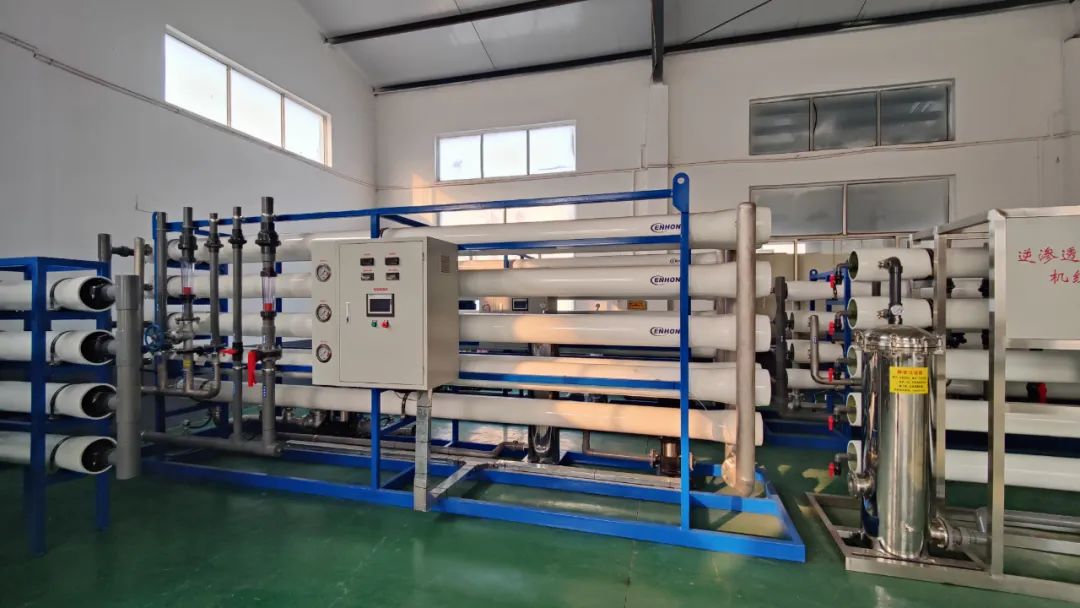
Avoid operating the membrane at high pressure
Residual gas remains when the system starts and stops, causing the system to operate under high pressure. The pressure gauges before and after the filter in the system are used to monitor the pressure drop of the filter element, and the primary and final pressure gauges are used to monitor the pressure drop of the RO membrane module. Adjust the water inlet valve and concentrated water valve to ensure operating pressure and recovery rate. If the produced water flow rate or the total flow rate drops during operation, or the pressure difference between the primary and secondary stages is greater than the pressure difference at the beginning of the operation (based on the initial operation data of the new reverse osmosis membrane module), the system needs to be flushed or cleaned. To ensure the performance and safety of membrane modules.
(1) After the equipment is emptied, when it is re-operated, the gas will quickly increase the pressure before it is exhausted. The remaining air should be exhausted under the pressure of the system, and then gradually increase the pressure for operation.
(2) When the joint between the pretreatment equipment and the high-pressure pump is not well sealed or leaks (especially the micron filter and the subsequent pipelines leak), when the pretreatment water supply is insufficient, such as the micron filter is clogged, In places with poor sealing, some air will be sucked in due to vacuum. The micron filter should be cleaned or replaced to ensure that the pipeline does not leak.
(3) Check whether each operating pump operates normally and whether the flow rate is the same as the specified value, and compare it with the pump operating curve to determine the operating pressure.
Pay attention to the operation when shutting down
(1) Rapid pressure reduction without thorough flushing when shutting down. Since the concentration of inorganic salts on the concentrated water side of the membrane is higher than that of the raw water, it is easy to scale and pollute the membrane. When preparing to shut down, gradually lower the pressure to about 3 bar and rinse with pretreated water for 14 to 16 minutes.
(2) When preparing to shut down, adding chemical reagents will cause the reagents to stay in the membrane and Frp Membrane Housing, causing membrane pollution and affecting the service life of the membrane. Dosing should be stopped.